
Cryptocurrency offers financial freedom by giving you full control of your assets – but with that control comes full responsibility. A fundamental saying in the crypto world is “Not your keys, not your coins.”
In practice, this means anyone who holds the seed phrase (also called a recovery phrase or mnemonic) for a wallet effectively controls the crypto in it. A seed phrase is typically 12 to 24 random words serving as the master password to your wallet. If someone obtains these words, they can take complete control of your crypto – no additional passwords or permissions needed. Likewise, if you lose your seed phrase, you lose access to your funds, with no “forgot password” reset option available.
In short, protecting this phrase is absolutely critical. This paper explores, in simple terms, why secure seed phrase storage matters and how tools like KryptoDots (a stainless-steel backup kit) help safeguard your crypto for the long run.
The Seed Phrase: Your One and Only Backup Key
What exactly is a seed phrase? It’s a human-readable backup of your wallet’s private keys – a list of common words that unlocks all the wallet’s addresses and funds. Think of it as a skeleton key for all your crypto accounts.
If your phone or hardware wallet is lost, damaged, or stolen, you can regenerate the entire wallet on a new device using this phrase. That makes the seed phrase the only lifeline to recover your assets in a disaster scenario. Unlike bank accounts or online services, there is no customer support to restore access if you misplace it. As one source puts it, “a seed phrase has no ‘forgot password’ option – if it’s lost or destroyed, the funds are gone permanently.”
Real-world stories underscore this finality: for example, a user famously lost 8,000 Bitcoin (worth hundreds of millions today) by accidentally throwing out a drive containing his keys – without a backup seed, that fortune remains unrecoverable in a landfill. Such cautionary tales drive home the point that losing your seed phrase can mean irreversible loss of all your crypto.
Security is equally paramount: anyone who gets hold of your seed phrase can steal your assets in minutes, with no way for you to stop it. There are no secondary PINs or biometric locks on a bare seed phrase – it is the ultimate secret. This is why wallets urge users to keep the phrase safe and offline.
In summary, a seed phrase is both powerful and perilous: it’s your safeguard if you protect it well, and the single point of failure if you don’t. The following sections will break down how to handle this responsibility, whether you’re a crypto beginner or seasoned holder, in plain non-technical language.
Hardware Wallets Are Only as Secure as Their Backup
Hardware wallets (popular brands include Ledger, Trezor, SafePal, Tangem, Ellipal, KeepKey, Cypherock, GridPlus, BitBox, and others) are often touted as one of the safest ways to store cryptocurrency. These physical devices keep your private keys offline, shielding them from online hackers.
However, a hardware wallet’s security can be completely undermined if the recovery seed is not stored securely. When setting up a device like a Ledger or Trezor, it will generate a 12- or 24-word seed phrase and instruct you to write it down on paper. The device itself usually comes with a blank recovery sheet for this purpose.
Why do they insist on writing it down? Because saving the seed phrase on a computer or phone essentially defeats the purpose of using a hardware wallet. If you were to store those words in a notes app, email, cloud drive, or any internet-connected device, they could be exposed to malware or hackers, bypassing the hardware wallet entirely.
In other words, if your seed phrase touches an insecure digital environment, an attacker could copy it and access your funds without needing your hardware device at all. Crypto experts warn never to keep your secret phrase in digital form – no screenshots, no plaintext files, not even in password managers – since that introduces unnecessary risk.
The whole design of hardware wallets assumes the seed remains cold (offline). The moment it goes hot (online), your vault’s master key may be compromised. To put it simply, protecting the seed phrase is the “other half” of hardware wallet security. The device safeguards your keys during everyday use, but the seed phrase is what safeguards you if the device is lost or fails. A Ledger or Trezor can only protect your crypto as long as no one else has your recovery phrase and you don’t lose it yourself.
Keep in mind these basic rules for seed phrase safety:
- Never share it with anyone. No legitimate support staff or friend should ever need your seed phrase – if someone asks for it, it’s a scam.
- Never store it on any digital device or cloud service. This means do not take a photo or screenshot of it, don’t email it to yourself, don’t save it in a notes app or cloud drive. A seed stored online can be stolen by hackers or malware.
- Keep it offline and in a secure place. Write it down on paper (or use a specialized metal backup) and lock it somewhere safe, like a home safe or safety deposit box. Ideally, keep two copies in separate secure locations to hedge against one being lost or destroyed.
Following these practices ensures that even if your hardware wallet device is destroyed or your computer is hacked, your crypto remains safe. The seed phrase is like a spare master key – it should be treated with the same caution (or more) as the device itself.
No Second Chances: Why Losing or Exposing the Seed Is Devastating
It’s worth emphasizing what’s at stake if a seed phrase is mishandled. If someone obtains your seed phrase, they effectively own your coins. The seed phrase can recreate all your private keys, so an attacker can simply load those words into their own wallet and instantly transfer out your funds with zero recourse.
There are many avenues by which seed phrases get exposed: malware might scrape an unsecured text file or photo of the seed, phishing scams might trick users into entering their phrase on a fake website, or a thief could literally find a written seed hidden in a drawer. One high-profile example occurred in 2022, when a crypto fund owner’s seed phrase was compromised and hackers drained $42 million from his wallet. Sadly, in crypto there is no fraud hotline to call in such cases – transactions can’t be reversed, and stolen coins usually can’t be recovered. This is why keeping the seed phrase secret is absolutely non-negotiable.
Conversely, if you lose your own seed phrase (and have no other backup), you lose access to your money forever. This scenario is less visible but just as tragic. Approximately 20% of all Bitcoin is believed to be permanently lost, much of it due to people misplacing or forgetting their keys/phrases.
Imagine a long-term investor who wrote their 24 words on a piece of paper years ago and then, during a house move or office cleanup, that paper gets lost. Without those words, all the BTC or ETH in that wallet is as good as gone – even the most skilled technicians or blockchain companies cannot help recover it. We saw earlier the example of the 8,000 BTC hard drive in a landfill; another common story is early adopters tearing apart their storage looking for a tiny backup paper they hid too well, often in vain.
There is simply no password reset or customer support to retrieve a lost seed phrase. Thus, the responsibility falls entirely on the user to both protect it from others and preserve it for themselves. Any plan for secure seed phrase storage must address both of these needs: keeping it out of the wrong hands, and keeping it safe from loss or destruction.
The Problem with Paper Backups
Given the above, the industry’s default advice has been to write the seed phrase on paper and hide it securely. Paper is indeed offline, which makes it immune to online hacking. Writing down your 12 or 24 words is quick, simple, and doesn’t rely on any technology. For many users, a notebook or the recovery card that came with their wallet is their primary backup.
This is certainly better than saving the seed on a phone or PC, but paper has serious weaknesses as a long-term security solution.
First, paper is physically fragile and vulnerable to accidents. Think about the typical hazards that could befall a small piece of paper over the years: fire can incinerate it, water can soak or smear it, and everyday mishaps (spilled coffee, mold, pests) can ruin it. One unfortunate incident could wipe out that backup completely. People don’t often imagine their house burning down or a pipe bursting, but such disasters do happen. If your only copy of the seed phrase is on paper, a single calamity could obliterate your wallet access in an instant.
Paper also doesn’t age well – over time it can degrade; ink can fade or blur, especially if exposed to sunlight or humidity. Many long-time holders plan to keep crypto for decades (“HODLing” for retirement, etc.), but the paper you wrote your key on might yellow, fade, or crumble in that span. There’s a real worry that 10 or 20 years down the line, a seed phrase scrawled in pen could become illegible or lost amidst life’s changes.
Another concern is theft or prying eyes. A seed phrase on paper is in plain text – 12 or 24 English words that anyone can recognize if they know about crypto. If someone stumbles upon that paper (be it a dishonest visitor, roommate, or even a curious family member), they could copy those words and steal your funds without you knowing until it’s too late. Hiding the paper can mitigate this risk, but hiding places can be discovered or accidentally revealed. Unlike a password that’s tucked away in your brain, a written seed is a physical object that could be found. Even the act of taking it out to check or use it carries some risk if others are around.
In short, while paper backups are offline and convenient, they are far from foolproof. The most common medium for seed storage is also the most frail: “Paper… can burn, get soaked, or degrade, and ink can fade over time,” as one report bluntly states. These weaknesses have prompted security-conscious crypto users to seek more durable and robust ways to secure their recovery phrases. After all, it’s a bit ironic that cutting-edge digital assets often rely on a piece of paper as the last line of defense. The good news is that better solutions exist – ones designed to withstand fires, floods, and the test of time, which we explore next.
The Stainless-Steel Solution: Lasting Peace of Mind
Instead of writing words on paper, users encode them by marking holes on a steel plate, creating a durable record of their recovery phrase. Imagine a backup for your secret phrase that could survive a house fire, a flood, or decades of storage without a scratch.
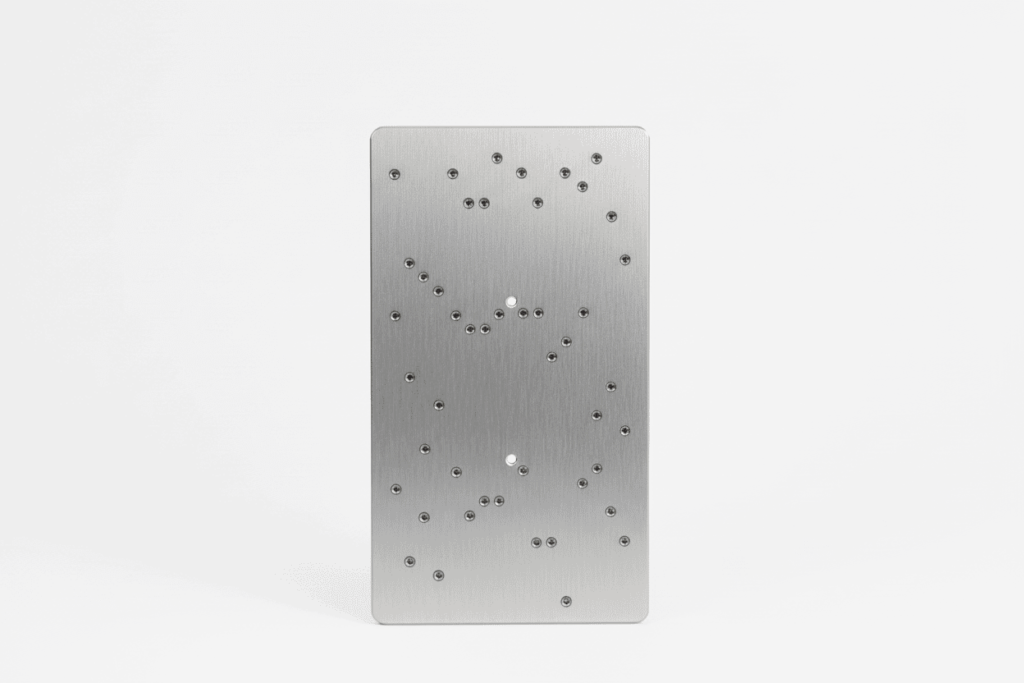
Figure: A KryptoDots stainless-steel plate punched with a sample seed phrase. Can you decode it?
Metal seed phrase storage kits offer exactly this kind of resilience. One example is KryptoDots, a backup kit that lets you permanently record your seed phrase on a 304 stainless steel plate. Stainless steel is tough – it doesn’t burn at normal fire temperatures, withstanding heat up to about 1400 °C (2550 °F), far hotter than an average house fire. It’s waterproof and corrosion-resistant, so it won’t rust or disintegrate even if submerged or exposed to the elements. It also resists crushing, bending and other physical stresses that would easily tear or shred paper.
In other words, a steel backup is built to survive scenarios that would obliterate a paper backup. By encasing your mnemonic in steel, you essentially disaster-proof your crypto keys, ensuring that no matter what happens – fire, flood, or other calamity – your seed phrase remains intact.
Durability is only one benefit. Kits like KryptoDots also tackle the privacy and security aspect in clever ways. Instead of stamping or engraving the actual words (which could be read by anyone who sees the plate), KryptoDots uses an ingenious dot encoding system.
Here’s how it works in simple terms: Every word on the standard BIP-39 word list (the list of 2048 possible seed words) is numbered. For each of your 12 or 24 words, you use the provided template to punch a pattern of dots that corresponds to that word’s number. The result looks like a grid of holes and dots rather than readable letters.
To an untrained eye or an unwanted viewer, the steel plate doesn’t scream “secret code” or “crypto keys” – in fact, the KryptoDots plate is unbranded and nondescript, resembling just a piece of metal with some bumps. If a thief or snooper were to find it, they wouldn’t immediately know it holds a seed phrase (there’s no “Bitcoin password” label or obvious words). Without the decoding key or knowing your specific method of dot encoding, the plate is useless to an attacker. For extra security, you can even apply a personal tweak or offset to the encoding (for example, swapping certain columns or using a custom numbering scheme known only to you), which makes it virtually impossible for anyone but you to decipher the phrase.
In essence, metal backups like this keep your seed secret as well as safe from physical harm – combining strong physical security with low visibility.
Using a steel backup kit might sound complex, but it’s designed to be straightforward and user-friendly. The KryptoDots system, for instance, works in three simple steps:
- You look up each of your seed words in the included wordlist booklet to find its number (between 1 and 2048).
- You place an encoding template over the steel plate and mark the dot positions for each word’s number.
- You then use the center punch tool to permanently punch those marked dots into the plate with a hammer.
There’s no electronics, no batteries – it’s a purely mechanical, “low-tech” process, which is a good thing for security. Because it’s offline and manual, there’s zero risk of hacking or data leakage during the backup process.
Once done, you have a permanent, tamper-proof record of your recovery phrase. You could bury it in the backyard, lock it in a vault, or hide it in a closet – it won’t mind humidity, heat, or the passage of time. Decades from now, those dots will still read the same words they do today. For long-term “HODLers,” this kind of longevity is a huge advantage over paper.
It’s worth noting that KryptoDots is one of several products in the growing category of metal seed backups (others include solid steel capsule kits, engraving plates, and fireproof tablets). The exact methods differ – some involve stamping letters, others use tiles or washers – but the core idea is consistent: use steel (or titanium) to protect the irreplaceable seed phrase.
What sets KryptoDots apart is the encoded dot format, which, as described, adds an extra layer of secrecy. The steel itself provides the robustness: for example, KryptoDots plates are made of high-grade 304 stainless steel with a melting point around 1400 °C, giving confidence it can survive extreme heat. They are also tested to resist corrosion and mechanical shock, meaning the information punched into them won’t degrade over time. By educating users on the fragility of paper vs. the permanence of steel, solutions like this highlight that a one-time investment now can protect one’s wealth for a lifetime. It transforms your seed phrase backup from a flimsy piece of paper into a solid metal insurance policy for your crypto assets.
Conclusion: Simple Steps to Protect Your Crypto Future
Securing your blockchain seed phrase may sound like a dry or technical topic, but at its heart it’s about protecting your financial future in the simplest, most reliable way possible. Whether you are a beginner who just bought your first hardware wallet or an experienced user holding crypto for years, the principles remain the same.
Your seed phrase is the master key to everything – treat it with care and respect. Never take shortcuts like storing it digitally or sharing it with others, as those moves can nullify even the best wallet security. The reason hardware wallets come with paper cards is that writing the seed down offline is vital, but remember that paper is only a starting point.
To truly secure your backup against life’s unpredictable turns, consider upgrading to a more durable medium. KryptoDots and similar stainless-steel backup kits exist because crypto enthusiasts recognized a clear need: “How do I keep my recovery phrase safe from any disaster?”
By encoding your precious words in steel, you drastically reduce the risk of loss – from the obvious threats like hackers and thieves (who can’t steal what they can’t find or read) to the subtler threats of time, decay, and forgetfulness. Think of it as locking away your wallet’s spare key in a vault that can withstand fire and flood. The peace of mind that comes from knowing your backup is literally solid is well worth the small effort to set it up.
In the end, investing a bit of time and resources now in secure seed phrase storage can save you from immeasurable heartbreak later. Your crypto journey can then continue with confidence, knowing that no single mishap will make you the next “lost keys” horror story. Secure your seed, secure your coins – and you’ll secure your future in the crypto world.
Leave a Reply